Why Metallic and Flake Systems Aren’t Just Different Colors
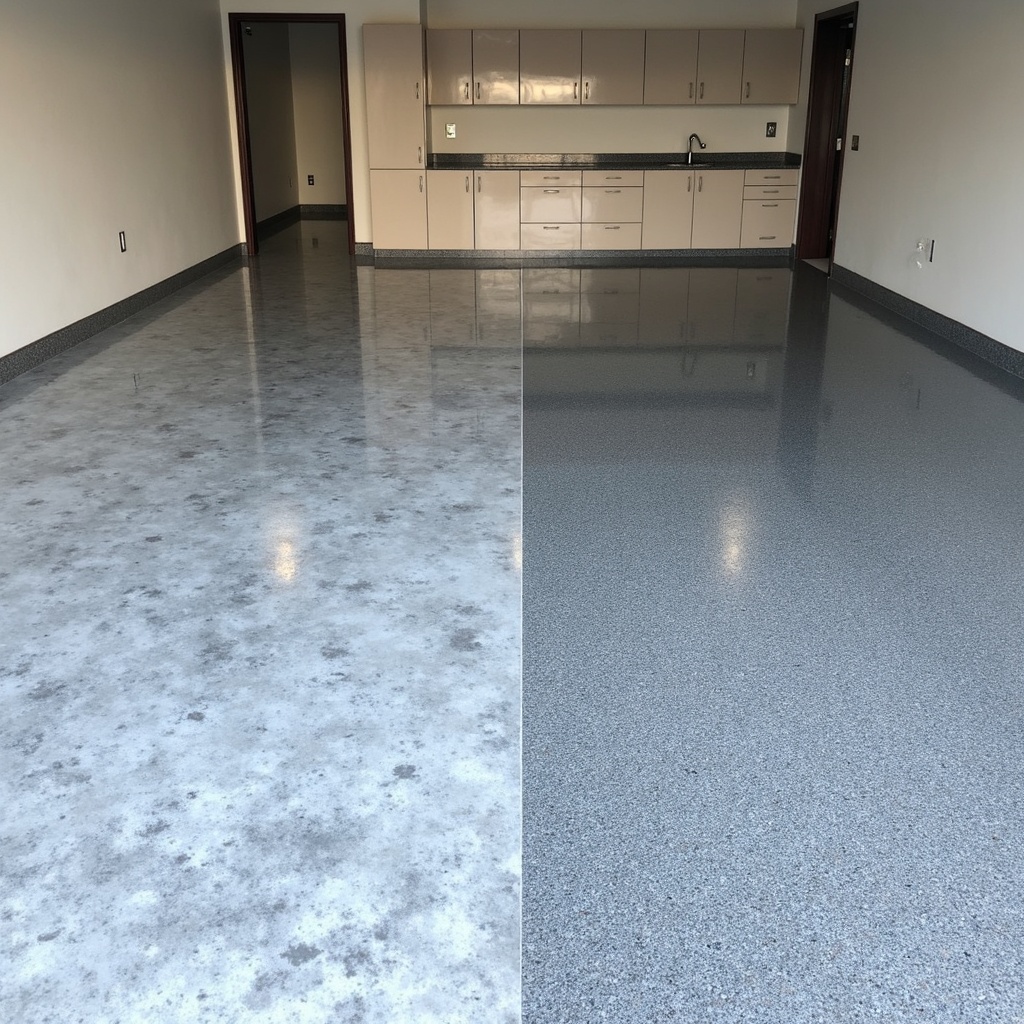
Many Granada Hills homeowners searching for garage floor upgrades assume metallic and flake epoxy systems are simply aesthetic variations of the same product. That misconception can cost you thousands. While both options transform concrete surfaces, metallic epoxy systems cost between $8 and $15 per square foot, compared to flake epoxy ranging from $5 to $10 per square foot. But the real difference lies in application complexity, installation timing requirements, and how each system responds to Granada Hills’ unique climate patterns throughout the year.
📋 In This Guide
💰 Granada Hills Premium Garage Floor Cost Ranges
- Flake Epoxy System (2-car garage, 500 sq ft): $2,500–$5,000
- Metallic Epoxy System (2-car garage, 500 sq ft): $4,000–$7,500
- Surface Preparation & Repairs: $1–$3 per square foot additional
- Premium Polyaspartic Topcoat: $1–$2 per square foot
- Custom Color Matching: $200–$500 flat fee
When Valley Weather Dictates Your Installation Window
Granada Hills sits in the northwest San Fernando Valley where summer temperatures routinely exceed 95°F and winter nights can drop to the low 40s. These temperature swings aren’t just uncomfortable—they fundamentally alter epoxy chemistry and determine when you can successfully install each system type.
Spring Installation: The Goldilocks Season for Both Systems
March through May offers the most forgiving conditions for both metallic and flake installations in Granada Hills. Daytime temperatures between 65°F and 80°F allow proper epoxy curing without the flash-cure problems that plague summer installations. Metallic systems particularly benefit from this stability because their complex layering technique requires extended working time to create the signature marbled patterns. A rushed metallic application in excessive heat produces muddy, indistinct color flows instead of dramatic veining.
For homeowners planning spring installations, book your epoxy flooring services in Granada Hills by late February. Reputable contractors fill their spring schedules quickly as demand peaks during this optimal window.
Summer Heat: Why Flake Systems Have the Advantage
June through September presents significant challenges for garage floor coatings in Granada Hills. When concrete surface temperatures exceed 90°F, epoxy can cure too rapidly, trapping bubbles and creating adhesion failures. Flake systems handle this pressure better than metallics for one critical reason: faster application. Contractors can broadcast vinyl flakes into the base coat within minutes, then immediately seal them with a topcoat. The entire process from prep to final cure takes 24-48 hours.
Metallic systems require multiple carefully-timed layers applied in specific patterns. In summer heat, the narrow working window between “too liquid” and “too set” shrinks from 20 minutes to as little as 8 minutes. This rushed timeline forces installers to work in smaller sections, creating visible seam lines that destroy the seamless marble effect. Experienced contractors like Five Star Epoxy & Coatings often schedule metallic installations for early morning starts (6 AM or earlier) during summer months, adding logistical complexity that flake systems simply don’t require.
Check out what summer heat does to application chemistry for detailed guidance on beating Valley temperature challenges.
Fall Window: Cost Advantages as Demand Drops
October and November represent the second-best installation window for both systems, with one financial advantage: reduced demand typically translates to 10-15% lower labor costs compared to spring pricing. Contractors who stayed busy through summer are eager to book fall projects before holiday season slowdowns. Granada Hills homeowners can leverage this timing to negotiate better rates, particularly for metallic systems where labor comprises 60-70% of total project cost.
Fall also offers stable curing conditions similar to spring, though shorter daylight hours may require installers to use supplemental lighting for metallic pattern work. The artistic manipulation required for metallic finishes demands excellent visibility to achieve consistent results across large garage spaces.
Winter Restrictions: When to Wait
December through February creates the toughest installation environment in Granada Hills. Overnight temperatures below 50°F slow epoxy cure rates dramatically, extending project timelines from 2 days to 4-5 days. Worse, morning condensation on cold concrete can prevent proper adhesion, requiring contractors to heat the slab before application—an added expense of $200-400 for equipment rental.
Both metallic and flake systems suffer in these conditions, but metallics face additional challenges. The extended working time that cold temperatures provide might seem beneficial for complex pattern work, but it actually creates a different problem: pigment separation. Metallic particles that should remain suspended in the resin can settle unevenly when the coating stays liquid too long, producing blotchy results instead of elegant swirls.
| Installation Timing Factor | Flake System Impact | Metallic System Impact |
|---|---|---|
| Summer Heat (90°F+ concrete) | Manageable with early morning starts; fast application minimizes heat exposure | Severely compressed working time; risk of visible seams and incomplete patterns |
| Winter Cold (Below 50°F nights) | Extended cure time (3-4 days vs. 2 days); condensation risk requires heating | Pigment separation issues; cure time can extend to 5-6 days; pattern quality suffers |
| Spring/Fall Ideal Window | Standard 2-day installation; predictable results; peak contractor demand | Optimal 2-3 day installation; best pattern development; highest booking competition |
| Humidity Considerations | Less sensitive; full flake broadcast hides minor imperfections from humidity | Highly sensitive; humidity can cloud the clear finish and dull metallic effects |
Material Cost Breakdown: Understanding the Premium
The price gap between metallic and flake systems originates in raw material costs before labor even enters the equation. Standard vinyl flakes used in decorative systems cost $0.40-$0.60 per square foot of coverage when broadcast at full density. Metallic pigments, by contrast, run $2.50-$4.00 per square foot just for the colorant additives.
Flake System Materials
A typical 500-square-foot Granada Hills two-car garage requires approximately 15 pounds of vinyl flakes for full broadcast coverage (the most popular aesthetic), costing $200-$300 in materials. The base epoxy resin runs another $300-$400, and the polyaspartic topcoat adds $250-$350. Total material cost: $750-$1,050, representing roughly 25-30% of the $2,900 to $4,600 total project cost for a 2-car garage in Southern California.
Homeowners can select from dozens of flake color combinations at no additional charge with most contractors. Custom blends created from multiple flake colors might add $100-$200 to create unique patterns that complement your home’s exterior or match specific color schemes common in Granada Hills neighborhoods like Knollwood or Granada Hills North.
Metallic System Materials
Metallic systems demand higher-grade base epoxies specifically formulated to keep heavy metallic particles in suspension. These specialized resins cost $500-$700 for the same 500-square-foot garage. The metallic pigments themselves—available in colors ranging from copper and bronze to silver, gold, and custom tints—add another $1,250-$2,000. Multiple clear topcoats required to protect the metallic finish and add depth contribute another $400-$600. Total material cost: $2,150-$3,300, representing 50-55% of total project expenses.
This material-heavy cost structure means metallic systems offer less room for negotiation. When a contractor quotes $6,000 for a metallic installation versus $3,500 for flakes, the difference isn’t inflated profit margins—it’s genuine material cost differential.
Labor Complexity: Why Metallics Command Premium Rates
Installation time directly impacts your final invoice. Flake systems follow a straightforward three-step process: apply base coat, broadcast flakes while wet, apply topcoat after base cures. A two-person crew completes a standard two-car garage in 12-16 working hours across two days. Labor costs typically range from $1 to $7 per square foot, with about $500 covering a day’s work for a two-person team.
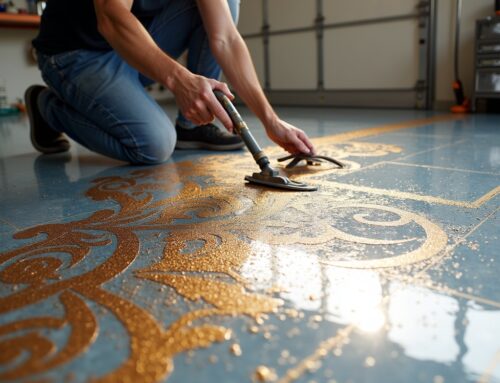
Metallic installations require artistic skill beyond standard epoxy application. Installers use specialized tools—notched rollers, foam brushes, and even air blowers—to manipulate the metallic-laden epoxy into flowing, organic patterns. This manipulation must occur within a narrow time window as the epoxy begins to gel. The process can’t be rushed: achieving the signature three-dimensional depth requires working in sections, allowing each area to develop its pattern before moving to the next while maintaining seamless transitions.
For a 500-square-foot garage, metallic installation consumes 20-28 working hours over 2-3 days. The extended timeline isn’t padding—it’s allowing proper cure time between the multiple clear coats (typically 3-4 layers) required to achieve the glass-like depth that makes metallic floors stunning. Each clear coat layer requires 6-8 hours of cure time before the next application.
This labor intensity explains why epoxy flooring contractors in Porter Ranch and throughout the Valley charge 40-60% more for metallic installations even when material costs are factored out.
Longevity Analysis: Ten-Year Cost Comparison
Initial installation cost tells only part of the financial story. Granada Hills homeowners need to evaluate maintenance requirements and expected lifespan to understand true cost-per-year ownership.
Flake System Longevity
Professional solid epoxy installations last 10 to 20 years when properly maintained. Flake systems typically fall in the 12-15 year range under normal residential garage use—parking two vehicles, occasional workshop activities, storing seasonal items. The vinyl flakes themselves never degrade, and the polyaspartic topcoat provides excellent UV resistance, preventing the yellowing that plagued older epoxy systems.
Maintenance costs remain minimal: occasional sweeping and quarterly mopping with pH-neutral cleaners. Every 5-7 years, you may want to apply a fresh topcoat ($1-2 per square foot, or $500-$1,000 for a two-car garage) to restore high-gloss appearance, though this is aesthetic preference rather than structural necessity. Total 10-year cost including initial installation and one topcoat refresh: approximately $3,500-$6,000.
Metallic System Longevity
Metallic systems utilize the same durable epoxy chemistry as flake systems, delivering similar 12-15 year structural lifespan. However, their aesthetic lifespan—the period where they maintain that dramatic, showroom appearance—can be shorter without proper care. The multiple clear coat layers that create depth are more susceptible to fine scratching from dragged tools, dropped equipment, or abrasive dirt tracked in from Granada Hills’ dusty conditions near O’Melveny Park’s trail access points.
To maintain the mirror-like finish, metallic floors benefit from topcoat renewal every 4-5 years rather than 5-7 years. Because metallics require thicker clear coats, this maintenance costs $1,200-$1,800 per application. Total 10-year cost including initial installation and two topcoat refreshes: approximately $7,000-$11,000.
This longevity analysis reveals metallic systems cost roughly 75-85% more over a decade—not the 60% premium suggested by installation costs alone. For homeowners prioritizing long-term value, flake systems deliver better cost-efficiency despite their less dramatic aesthetic.
When Garage Size Changes the Equation
Metallic epoxy’s visual impact scales with floor area. In compact single-car garages (200-250 square feet), the flowing patterns don’t have sufficient space to develop their full organic complexity. You’re paying premium prices for an effect that reads as “busy” rather than “elegant.” Industry professionals generally recommend metallics only for spaces exceeding 350 square feet where patterns have room to breathe and develop visual flow.
Conversely, flake systems work beautifully at any scale. The random distribution of colored chips looks intentional and finished in a 200-square-foot workshop or a 1,200-square-foot three-car garage. This scalability makes flakes the superior choice for Granada Hills homes with non-standard garage configurations—converted single garages, tandem parking spaces, or L-shaped multi-use areas.
Cost Per Square Foot vs. Total Project Impact
Here’s where cost psychology influences decisions. For a standard 500-square-foot two-car garage, the difference between a $3,500 flake installation and a $6,000 metallic installation is $2,500—a significant sum. But for homeowners upgrading a 900-square-foot three-car garage (common in newer Granada Hills homes), that same quality differential might run $4,500-$5,500.
Paradoxically, larger projects sometimes favor metallics despite higher absolute cost because the per-square-foot premium decreases slightly. Material costs benefit from bulk purchasing, and the labor-intensive pattern work requires similar skill regardless of whether the crew works 500 or 900 square feet. You might pay $12 per square foot for a small metallic job but only $9-10 per square foot for a large one.
Resale Value Impact in Granada Hills Market
With median home values around $818,900 in Granada Hills, garage upgrades represent a small percentage of overall property value but disproportionately influence buyer perception. Real estate professionals report that professionally finished garages create strong first impressions—many potential buyers enter homes through garage doors, making this space part of the critical “first 10 seconds” that shape opinions.
Both metallic and flake systems deliver positive ROI, but in different ways. Flake systems read as “well-maintained and practical” to the broadest buyer demographic. They signal that the seller invested in home quality without making bold stylistic choices that might not align with buyer preferences. In Granada Hills’ family-oriented neighborhoods like Old Granada Hills and Granada Hills South, this universal appeal helps homes move faster.
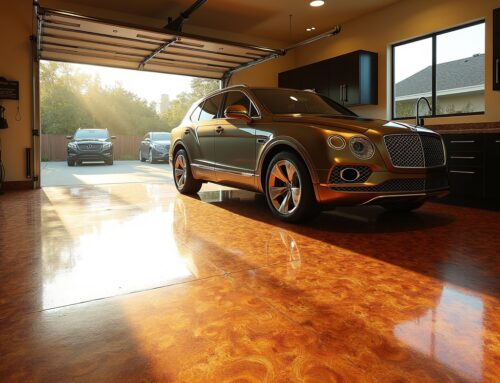
Metallic systems make stronger style statements. They transform garages into showroom spaces that photograph beautifully for listings and create memorable viewing experiences. However, this distinctiveness can polarize buyers. Some immediately increase their offer because they love the aesthetic; others mentally calculate replacement costs if the bold metallic finish doesn’t match their vision.
For investment properties or homes likely to sell to conservative buyers, flake systems represent safer choices. For luxury homes or properties targeting design-conscious buyers, metallics can justify their premium by elevating the entire property’s perceived finish level. Before choosing, consult with a local realtor familiar with Granada Hills buyer preferences—market dynamics shift, and current trends influence which option maximizes return.
Making Your Decision: A Timing-Based Framework
Your optimal choice depends on installation timeline, budget flexibility, and aesthetic priorities working together. Here’s a decision framework based on when you’re planning the project:
If You’re Installing in Next 30-60 Days
Check the current season and Granada Hills weather forecasts. Installing in July or January? Strongly favor flake systems—they’re more forgiving of temperature extremes and deliver reliable results when conditions are suboptimal. Installing in April, May, October, or November? Both systems are viable; base your choice on budget and aesthetic preference rather than installation constraints.
If You’re Planning 3-6 Months Out
You have the luxury of scheduling during optimal weather windows, removing installation complexity from the decision equation. Focus on long-term value: will you keep this home 10+ years (favoring lower-maintenance flakes) or sell within 5 years (potentially justifying metallic’s showroom appeal)? If you’re unsure, split the difference—consider a flake system with larger, more dramatic flake sizes and multi-color blends that approach metallics’ visual interest at flake-system prices and maintenance requirements.
If Budget Is Primary Concern
Flake systems deliver 80% of the aesthetic upgrade at 60% of the cost when compared to metallics. That value proposition is difficult to beat. If you’re drawn to metallic aesthetics but concerned about cost, explore whether your contractor offers metallic borders or accent sections within an otherwise flake floor—a design compromise that incorporates both systems at reduced total expense.
Residents in nearby areas can also explore similar options through epoxy flooring in Northridge for competitive quotes and seasonal availability.
Schedule Your Granada Hills Consultation
The metallic versus flake decision ultimately hinges on your specific garage conditions, timeline, and long-term plans for your Granada Hills home. Five Star Epoxy & Coatings provides detailed on-site assessments that evaluate your concrete’s current condition, discuss seasonal timing strategies, and present accurate cost estimates for both system types. Rather than choosing based on online research alone, seeing physical samples under your garage’s specific lighting conditions—and understanding how installation timing affects results in your microclimate—produces better decisions and fewer regrets.
Call (818) 355-3804 to schedule your no-obligation consultation. During spring and fall peak seasons, booking 4-6 weeks in advance ensures you secure preferred installation dates during optimal weather windows. Our team brings sample boards showcasing both metallic and flake finishes to your property, allowing you to visualize options in your actual space rather than relying on generic photos that don’t capture how these surfaces look under your garage’s specific conditions.
For homeowners still researching, review our pre-installation checklist for Valley summer conditions to understand preparation requirements, or explore our completed project gallery showing both metallic and flake installations in Granada Hills and surrounding San Fernando Valley communities. The right garage floor system transforms not just your space’s appearance but its functionality for years to come—making the investment in proper research and seasonal timing well worth the effort.