Epoxy Flooring for Restaurants and Commercial Kitchens: Safety, Codes, and Best Practices
Restaurant kitchens face strict health department and slip-resistance requirements that most standard flooring cannot meet. This guide breaks down exactly how epoxy flooring satisfies those codes and what to look for when choosing an installer.
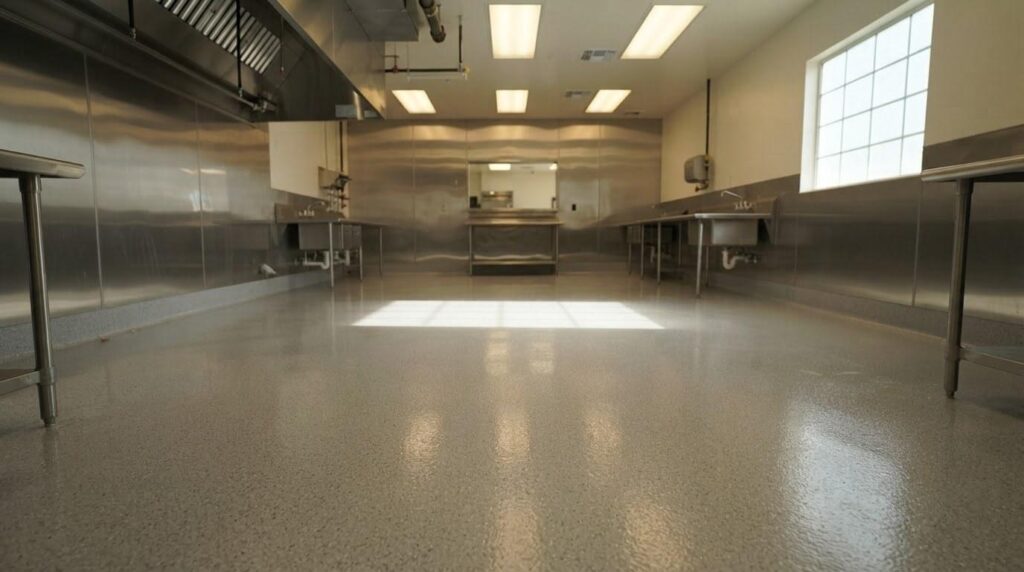
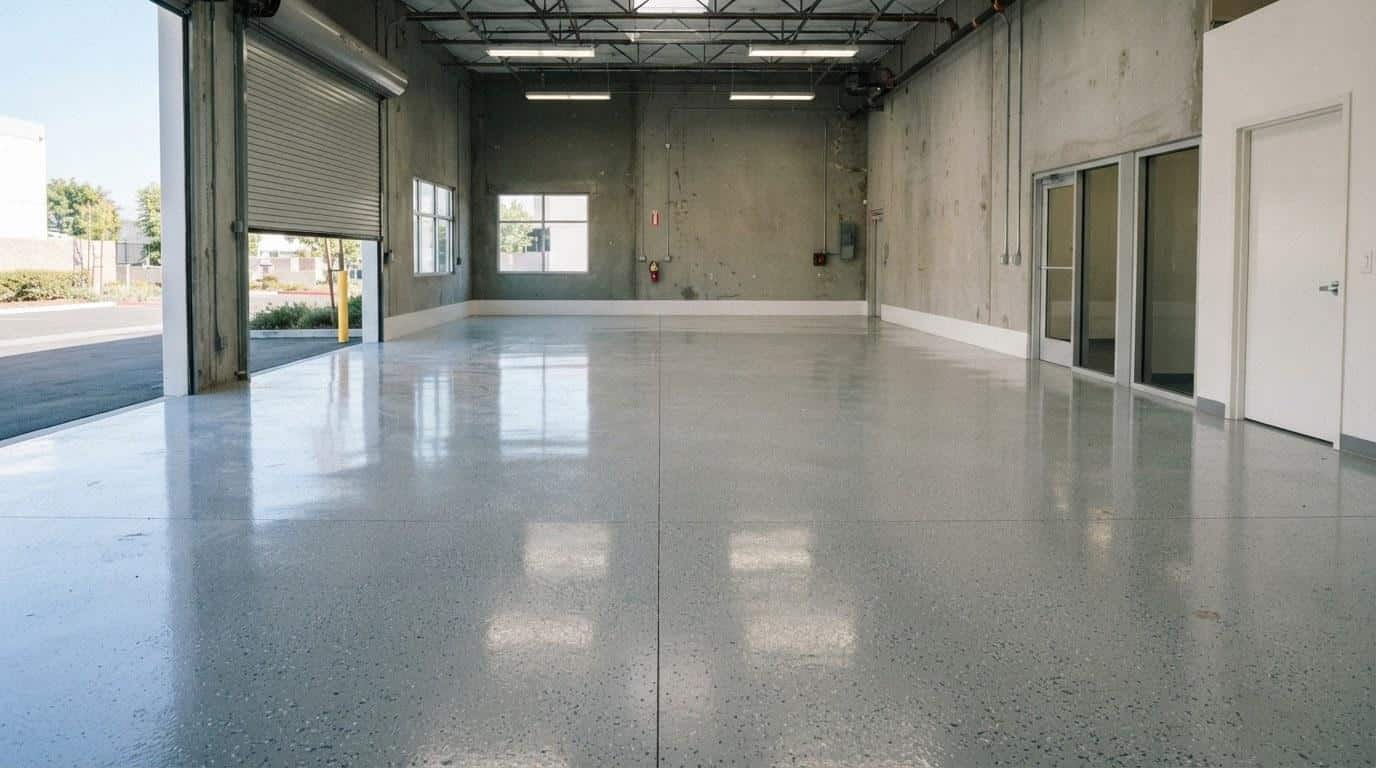
Epoxy flooring commercial kitchen safety codes guide: commercial kitchen floors must meet strict health department sanitation rules, OSHA slip-resistance standards, and local building codes all at once. Epoxy coatings, when properly formulated and installed, can satisfy every one of those requirements. This guide covers the specific codes that apply, the epoxy systems that qualify, and the installation practices that keep a kitchen in compliance year after year.
What Makes Epoxy Flooring a Strong Choice for Commercial Kitchens?
Epoxy creates a seamless, non-porous surface that does not absorb grease, bacteria, or cleaning chemicals. That single property addresses the core concern of every health inspector who walks through a restaurant kitchen.
Tile grout lines, bare concrete, and vinyl sheet flooring all trap food particles and moisture over time. Epoxy eliminates those gaps entirely. The result is a surface that can be sanitized with commercial-grade cleaners without the floor degrading or harboring pathogens.
Beyond sanitation, epoxy bonds directly to concrete and can withstand the thermal shock of steam cleaning, the impact of dropped equipment, and the constant foot traffic of a busy kitchen. A properly installed system will not crack, peel, or delaminate under normal commercial use.
Our crews regularly pull up failed tile and vinyl in commercial kitchens and find moisture damage and microbial growth underneath. The subfloor condition at the time of installation matters enormously, which is why surface preparation is the step that separates a long-lasting epoxy job from one that fails within a year.
What Safety Codes and Standards Apply to Commercial Kitchen Floors?
At least four separate regulatory frameworks govern commercial kitchen floors in California: the California Retail Food Code, OSHA slip-resistance guidelines, local building codes, and the Americans with Disabilities Act (ADA) surface requirements. Each one sets a different threshold, and a compliant floor must satisfy all of them simultaneously.
California Retail Food Code (CalCode)
The California Department of Public Health enforces the California Retail Food Code, which requires that food facility floors be smooth, durable, nonabsorbent, and easily cleanable. Epoxy meets all four descriptors when the correct system is used. Inspectors look for visible cracks, pitting, or areas where the coating has lifted, because those are the spots where bacteria survive cleaning cycles.
OSHA Slip-Resistance Requirements
OSHA’s walking-working surfaces standard (29 CFR 1910.22) requires that floors be kept clean and in good repair. For wet areas like commercial kitchens, the practical standard is a static coefficient of friction (COF) of at least 0.5 on dry surfaces and 0.6 or higher on wet surfaces. A smooth epoxy finish alone does not meet the wet COF threshold. The floor system must include an anti-slip aggregate, texture, or broadcast material to bring the wet COF into the compliant range.
A smooth epoxy finish alone does not meet the wet COF threshold of 0.6 required in commercial kitchen work areas.
ADA Surface Standards
The ADA Standards for Accessible Design require that floor surfaces be stable, firm, and slip-resistant. Changes in level greater than 0.5 inches must be beveled or ramped. Epoxy transitions between areas must be feathered or coved to avoid creating trip hazards at doorways and thresholds.
Local Building and Fire Codes
California’s Title 24 building standards and local fire codes may also specify floor surface requirements in areas near cooking equipment, particularly around floor drains and grease traps. Always confirm requirements with the local authority having jurisdiction (AHJ) before installation begins.
| Regulatory Framework | Key Requirement | How Epoxy Addresses It |
|---|---|---|
| California Retail Food Code | Smooth, nonabsorbent, easily cleanable | Seamless surface with no grout lines or pores |
| OSHA 29 CFR 1910.22 | Wet COF of 0.6 or higher in work areas | Anti-slip broadcast or aggregate added to topcoat |
| ADA Accessible Design | Stable, firm, slip-resistant; level changes under 0.5 in. | Coved transitions, feathered edges at thresholds |
| California Title 24 / Local AHJ | Fire and chemical resistance near cooking equipment | Chemical-resistant topcoats rated for kitchen environments |
Which Type of Epoxy System Meets Restaurant Floor Requirements?
Not every epoxy product is suitable for a commercial kitchen. The three systems most commonly specified for food service environments are mortar epoxy, self-leveling epoxy with anti-slip broadcast, and chip and flake epoxy with a sealed anti-slip topcoat. Each has a different profile of durability, texture, and cost.
Mortar Epoxy (Heavy-Duty)
Mortar epoxy systems combine epoxy resin with a silica or quartz aggregate to build a layer that is typically 3 to 6 millimeters thick. This system handles the heaviest loads, resists thermal shock from steam cleaning, and provides inherent slip resistance from the aggregate texture. It is the most common choice for high-volume commercial kitchens and food processing areas.
Self-Leveling Epoxy with Anti-Slip Broadcast
Self-leveling systems pour to a smooth, flat finish at about 2 to 3 millimeters thick. On their own, they are too slick for a wet kitchen environment. The solution is a broadcast of aluminum oxide or silica sand into the wet topcoat, which raises the COF into the compliant range without creating deep texture that traps food debris.
Chip and Flake Epoxy Flooring
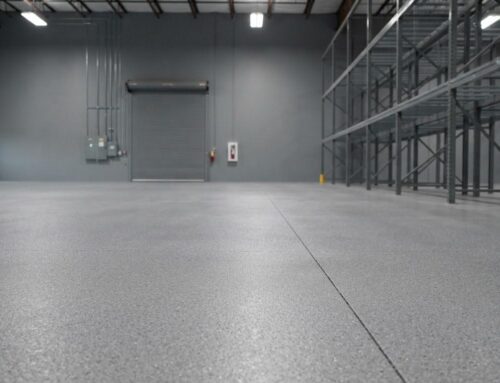
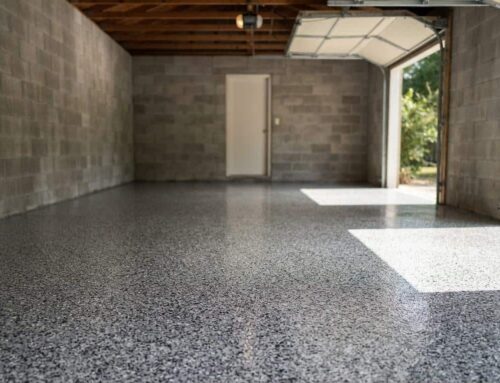
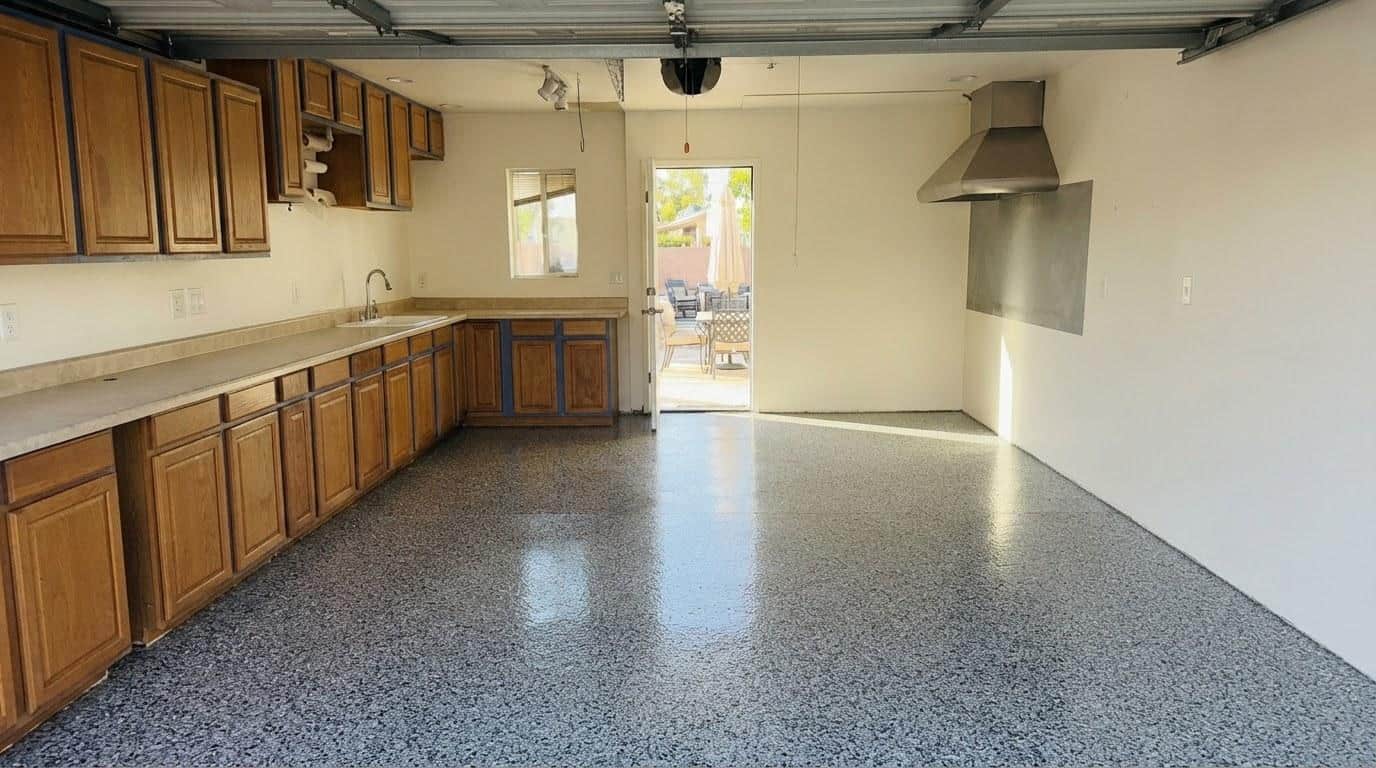
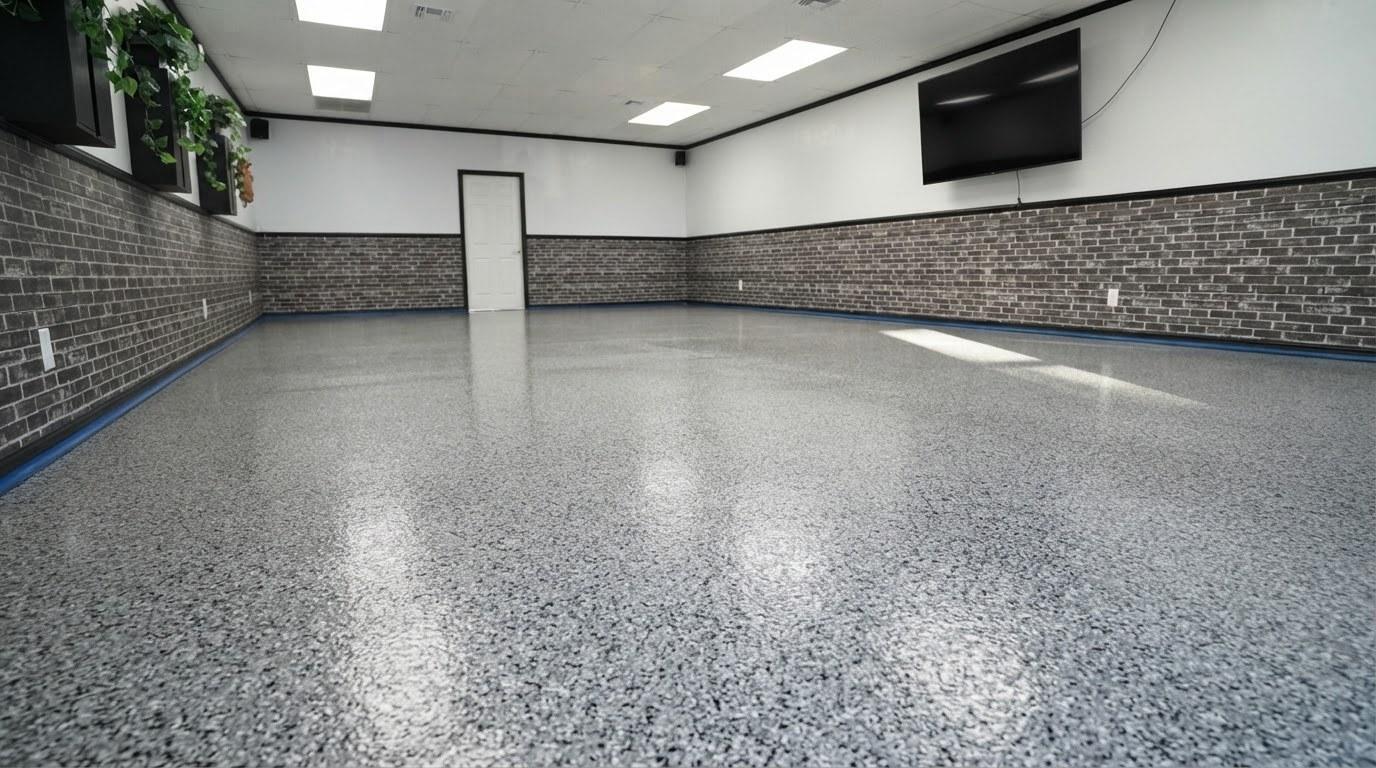
Chip and flake epoxy flooring uses colored vinyl flakes broadcast into a base coat, then sealed with a clear topcoat. The flake texture naturally increases slip resistance, and the multi-layer system seals the surface completely. This system is popular in prep areas, walk-in cooler entries, and front-of-house spaces where appearance matters alongside function. A matte or satin anti-slip topcoat keeps the COF in the compliant range even when wet.
What to Avoid
- Thin-coat decorative epoxy: Systems under 1 millimeter thick are not durable enough for commercial kitchen traffic and will show wear within months.
- High-gloss smooth topcoats: A mirror finish looks attractive but produces a wet COF well below 0.5, creating a serious slip hazard and a code violation.
- Solvent-based epoxy near food prep: Some older formulations off-gas solvents that require extended cure times before the space can be used safely. Specify water-based or 100% solids systems for food environments.
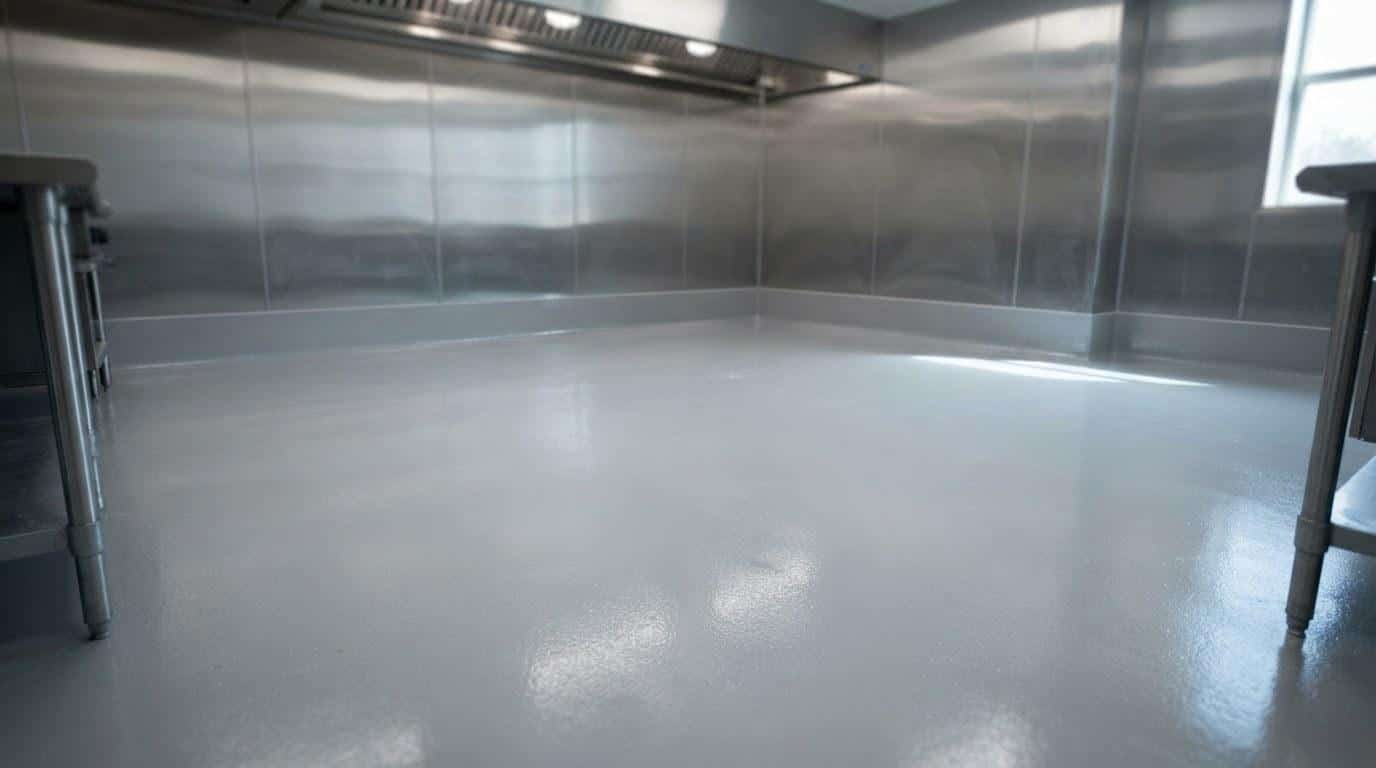
- Skipping cove base installation: Health codes require a coved base where the floor meets the wall to eliminate the seam where grease and bacteria accumulate. An epoxy cove base, typically 4 to 6 inches high, is part of a compliant installation.
How Long Does Commercial Kitchen Epoxy Flooring Last?
A properly installed commercial kitchen epoxy system typically lasts 10 to 20 years before requiring a full recoat, depending on traffic volume, cleaning frequency, and the thickness of the original system. Mortar epoxy systems on the heavier end of the thickness range consistently outperform thinner self-leveling systems in high-traffic zones.
Several factors shorten or extend that range. Daily cleaning with highly alkaline degreasers at concentrations above the manufacturer’s recommendation will break down the topcoat faster than normal. Thermal cycling from steam cleaning equipment, especially if done more than once per day, stresses the bond between layers over time. Floors that receive a maintenance recoat every 5 to 7 years often exceed the 20-year mark without a full removal and reinstall.
Floors that receive a maintenance recoat every 5 to 7 years often exceed the 20-year mark without a full removal and reinstall.
Chip and flake epoxy flooring in lighter-use prep areas or walk-in entries can last the full 15 to 20 year range with minimal maintenance because those zones see less chemical exposure than the hot line.
In our experience, the floors that fail early almost always share one root cause: inadequate surface preparation before the epoxy was applied. When the concrete substrate has not been properly ground, shot-blasted, or acid-etched, the epoxy bond is weak from day one and delamination begins within the first year of heavy use.
What Does Commercial Kitchen Epoxy Flooring Cost?
In the California market, commercial kitchen epoxy flooring projects typically range from $5 to $12 per square foot for standard self-leveling or chip and flake systems, and from $8 to $18 per square foot for mortar epoxy or heavily customized systems. The final number depends on the condition of the existing substrate, the system specified, the square footage, and any required cove base work.
Several cost factors move the number significantly:
- Substrate condition: Concrete that requires crack repair, grinding, or moisture mitigation adds to the prep cost before any epoxy is applied.
- System thickness: A 6mm mortar system uses significantly more material than a 2mm self-leveling coat, and the labor time increases proportionally.
- Cove base: Installing an epoxy cove base around the perimeter of a kitchen adds linear footage to the project scope and is often priced separately.
- Access and scheduling: Commercial kitchens that can only be worked on overnight or on a single closure day may carry a scheduling premium.
- Square footage: Larger projects generally benefit from a lower per-square-foot rate because setup and mobilization costs are spread across more area.
These figures represent regional market context only. For an accurate number tied to your specific space, request a custom quote from a qualified epoxy coating company that can assess the substrate in person.
What Are the Most Common Installation Mistakes to Avoid?
The most damaging mistakes in commercial kitchen epoxy installation happen before the first coat is applied. Skipping or rushing surface preparation is responsible for the majority of premature failures, but several other errors also create compliance and durability problems.
- Insufficient surface profile: Epoxy needs a concrete surface profile (CSP) of 3 to 5 for most commercial systems, per ICRI standards. A surface that has not been mechanically prepared to that profile will not hold the coating under heavy use.
- Ignoring moisture vapor emission: Concrete slabs in California, especially in coastal and inland valley climates, can emit moisture vapor at rates that cause epoxy to blister and delaminate. A calcium chloride test or relative humidity probe test should be completed before installation. Slabs emitting more than 3 pounds per 1,000 square feet per 24 hours typically require a moisture mitigation primer.
- Wrong topcoat for the environment: Using a standard clear topcoat instead of a chemical-resistant urethane or polyaspartic topcoat in a kitchen environment leads to yellowing, softening, and surface breakdown from repeated exposure to degreasers and hot water.
- No anti-slip additive in wet zones: Installing a smooth topcoat in a kitchen without an anti-slip broadcast is both a safety hazard and a code violation. This is one of the most common shortcuts taken by installers who are not familiar with this epoxy flooring commercial kitchen safety codes guide type of compliance work.
- Inadequate cure time before reopening: Most commercial epoxy systems require 24 to 72 hours of cure time before foot traffic, and up to 7 days before heavy equipment is moved back into position. Reopening too early damages the surface and voids most manufacturer warranties.
- Missing cove base: Failing to install an epoxy cove base at the wall-floor junction is one of the most common reasons a kitchen fails a health inspection after a new floor is installed.
Ready to Bring Your Kitchen Floor Into Compliance?
Commercial kitchen floors have to do more than look clean. They have to pass health department inspections, meet OSHA slip-resistance thresholds, and hold up to years of grease, steam, and chemical cleaning. Choosing the right epoxy system and a qualified installer who understands those requirements is the decision that determines whether your floor passes inspection on the first visit or becomes a recurring problem.
Five Star Epoxy & Coatings installs commercial epoxy flooring systems across Southern California for restaurants, food prep facilities, and commercial kitchens of all sizes. Call (818) 355-3804 to schedule a site assessment and get a written quote for your project. An in-person evaluation is the only reliable way to specify the right system for your substrate, your traffic load, and your local code requirements.
Frequently Asked Questions
Does epoxy flooring pass health department inspections in California restaurants?
Yes, epoxy flooring can pass California health department inspections when the correct system is installed. The California Retail Food Code requires floors to be smooth, nonabsorbent, durable, and easily cleanable. A properly installed seamless epoxy system with a coved base at the wall meets all four of those requirements. The key is using a food-safe, fully cured system with no cracks, lifting edges, or exposed seams.
What slip resistance rating does a commercial kitchen floor need?
OSHA guidelines recommend a static coefficient of friction (COF) of at least 0.6 for wet work areas like commercial kitchens. A smooth epoxy finish alone does not reach that threshold when wet. An anti-slip aggregate such as aluminum oxide or silica sand must be broadcast into the topcoat to bring the wet COF into the compliant range. Always ask your installer to specify the COF rating of the finished system before the project begins.
How long does epoxy flooring last in a commercial kitchen?
A properly installed commercial kitchen epoxy system typically lasts 10 to 20 years before requiring a full recoat. Mortar epoxy systems on the thicker end of the range hold up longest in high-traffic hot-line areas. Thinner self-leveling systems in lighter-use prep zones can also reach the 15 to 20 year mark with periodic maintenance recoats every 5 to 7 years. The biggest factor in longevity is the quality of surface preparation at the time of installation.
What is an epoxy cove base and do I need one for my restaurant kitchen?
An epoxy cove base is a curved epoxy transition installed where the floor meets the wall, typically 4 to 6 inches high. It eliminates the seam at the wall-floor junction where grease, bacteria, and moisture would otherwise accumulate. California health codes require this type of coved transition in food facilities, so it is not optional. It is installed as part of the epoxy system and is not the same as a separate rubber or vinyl cove molding.
How long does a commercial kitchen have to stay closed after epoxy is installed?
Most commercial epoxy systems require 24 to 72 hours before foot traffic is allowed, and up to 7 full days before heavy equipment is moved back into position. The exact cure time depends on the specific product, the ambient temperature, and the humidity level during cure. Reopening a kitchen too early can damage the surface and create compliance problems. Your installer should provide a written cure schedule as part of the project documentation.